Human-AI Interaction:

Human Multisensory Perception


Bagus Tris Atmaja
Assistant Professor – Human-AI Interaction

Motivation

  • Humans use multiple modalities to communicate (e.g., speech, facial expressions, gestures).
  • We sense the world through multiple channels — not just five.
  • This sub-course consists of two parts:
    • Multisensory perecption: how humans sense and interpret the world through our senses combine these channels.
    • Multimodal processing: how to design AI systems that can process and integrate information from multiple modalities.

Overview: Sensation, Perception & the Senses

Topic
Sensation vs. Perception
Waves and Wavelengths
Vision
Hearing
The Other Senses
Gestalt Principles of Perception

Sensation vs. Perception

Sensation — occurs when sensory receptors detect stimuli and convert them into neural signals sent to the brain.

Transduction — conversion from sensory stimulus energy to action potential.

Stimuli (sing. stimulus) — any detectable change in the internal or external environment.

Perception — the way sensory information is organized, interpreted, and consciously experienced.

Not all sensations result in perception.

Our Sensory Modalities

More than five senses exist:

Sense Modality
Vision Light
Hearing (audition) Sound waves
Smell (olfaction) Chemical
Taste (gustation) Chemical
Touch (somatosensation) Mechanical
Balance Vestibular
Body position/movement Proprioception & Kinesthesia
Pain Nociception
Temperature Thermoception

Absolute Threshold

Absolute threshold — minimum stimulus energy detectable 50% of the time.

Examples:

  • Candle flame visible from 30 miles away on a clear night
  • Clock tick audible from 20 feet away in quiet conditions

Subliminal messages — stimuli below threshold for conscious awareness. Research shows little effect on real-world behavior.

Difference Threshold & Weber's Law

Just noticeable difference (JND) — the smallest detectable difference between two stimuli.

Weber's Law: The difference threshold is a constant fraction of the original stimulus.

Example: A phone screen lighting up is obvious in a dark movie theater, but unnoticed in a brightly lit arena — same brightness, different context.

Bottom-Up vs. Top-Down Processing

Top-down processing uses prior knowledge; bottom-up processing is driven by sensory input.

Bottom-Up & Top-Down

Bottom-up: automatic, stimulus-driven, involuntary

  • e.g., crashing sound in a restaurant captures attention regardless of what you were focusing on

Top-down: goal-directed, deliberate, voluntary

  • e.g., scanning for a yellow key fob in likely locations, ignoring the ceiling fan

Sensation is physical; Perception is psychological.

Sensory Adaptation

Sensory adaptation — the decrease in sensitivity to a stimulus that remains constant over time.

Example: A flashing construction light outside your hotel window seems very annoying at first, but after watching TV for a while, you no longer notice it — even though your photoreceptors still detect it.

Attention & Inattentional Blindness

Inattentional blindness — failure to notice a fully visible stimulus because attention is elsewhere.

Simons & Chabris (1999): While counting basketball passes, nearly half of participants failed to notice a gorilla walking through the scene — visible for 9 seconds.

Signal detection theory — ability to identify a stimulus embedded in background noise; affected by motivation and expectation.

Inattentional Blindness

About ⅓ of participants missed a red cross on screen because attention was focused on black/white figures. (credit: Cory Zanker)

Cultural & Individual Effects on Perception

  • Beliefs, values, personality, and culture all shape perception.
  • Segall et al. (1963): Western cultures (carpentered world) more susceptible to the Müller-Lyer illusion; Zulu people (round structures) less susceptible.
  • Cross-cultural differences also found in odor identification and taste preferences.

Müller-Lyer Illusion

Lines appear to be different lengths although they are identical — a classic example of how top-down expectations shape perception.

Waves and Wavelengths

The key physical characteristics of a wave:

  • Amplitude — distance from center line to crest (peak) or trough; associated with intensity
  • Wavelength — length from one peak to the next; inversely related to frequency
  • Frequency — number of wave cycles per second, measured in hertz (Hz)

Higher frequency = shorter wavelength; lower frequency = longer wavelength.

Wave Amplitude and Wavelength

Figure 5.5 Amplitude is measured from peak to trough; wavelength is measured peak to peak.

Frequency and Wavelength

Figure 5.6 Waves of differing wavelengths and frequencies. From top to bottom: wavelengths decrease, frequencies increase.

Light Waves: The Electromagnetic Spectrum

Visible light is only a small portion of the full electromagnetic spectrum (380–740 nm). Other species detect beyond human range: honeybees (UV), some snakes (infrared).

Color and Wavelength

Different wavelengths correspond to different colors. Mnemonic: ROYGBIV.

  • Reds → longer wavelengths
  • Violets/Blues → shorter wavelengths
  • Amplitude → brightness/intensity

Sound Waves

  • Pitch ↔ frequency: high frequency = high pitch; low frequency = low pitch
  • Human audible range: 20–20,000 Hz
  • Loudness ↔ amplitude, measured in decibels (dB)
    • Conversation ≈ 60 dB; Rock concert ≈ 120 dB
    • Hearing damage risk from ~80 dB; pain threshold ~130 dB
  • Timbre — a sound's purity; explains why instruments sound different at same pitch and loudness

Loudness of Common Sounds

Loudness levels of common sounds: ~⅓ of all hearing loss is due to noise exposure.

Vision: The Eye

Our eyes gather sensory information for interpreting the world.

Key structures:
cornea → pupil → lens → retina → fovea → optic nerve

Photoreceptors: Rods and Cones

Cones (green) are concentrated in the fovea; rods (blue) cover the rest of the retina.

Rods Cones
Location Periphery Fovea
Light condition Dim Bright
Function Motion, low-light Color, detail

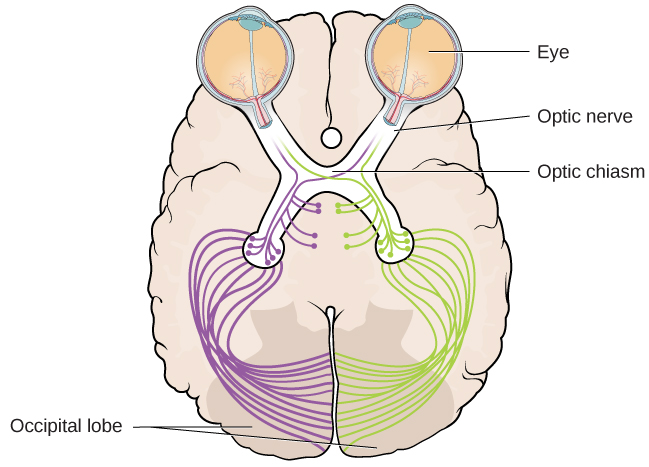
At the optic chiasm, right-visual-field info goes to left hemisphere and vice versa. Processed in occipital lobe.

  • "What" pathway — object recognition
  • "Where/How" pathway — location and spatial interaction

Color Vision

Trichromatic theory: three cone types sensitive to red, green, and blue; all colors produced by combining these.

Opponent-process theory: color coded in opponent pairs (red-green, blue-yellow, black-white). Explains negative afterimages.

Both theories apply — trichromatic at the retina level; opponent-process further up toward the brain.

Trichromatic Theory

Sensitivity curves for the three cone types. Red-green color blindness affects ~8% of European males.

Negative Afterimage

Stare at the white dot for 30–60 seconds, then look at a white surface. The afterimage demonstrates opponent-process theory.

Depth Perception

Binocular cues (both eyes):

  • Binocular disparity — slightly different view from each eye; basis of 3-D movies

Monocular cues (one eye):

  • Linear perspective — parallel lines converge in the distance
  • Interposition — partial overlap of objects
  • Relative size, closeness to horizon

Linear Perspective (Monocular Depth Cue)

We perceive depth in a 2-D image through monocular cues like converging parallel lines. (credit: Marc Dalmulder)

Hearing

The ear: outer (pinna, tympanic membrane), middle (ossicles: malleus, incus, stapes), inner (cochlea, basilar membrane).

How We Hear

Sound waves → tympanic membrane → ossicles → oval window → cochlear fluid → hair cells → auditory nerve → brain (auditory cortex in temporal lobe)

Hair cells are the auditory receptor cells. Their mechanical activation generates neural impulses.

Pitch Perception

Two theories:

Temporal theory — frequency coded by firing rate of hair cells. Limited to ~4,000 Hz.

Place theory — different parts of basilar membrane respond to different frequencies. Base = high frequency; tip = low frequency.

Both apply: up to ~4,000 Hz, both rate and place contribute. Higher frequencies rely on place alone.

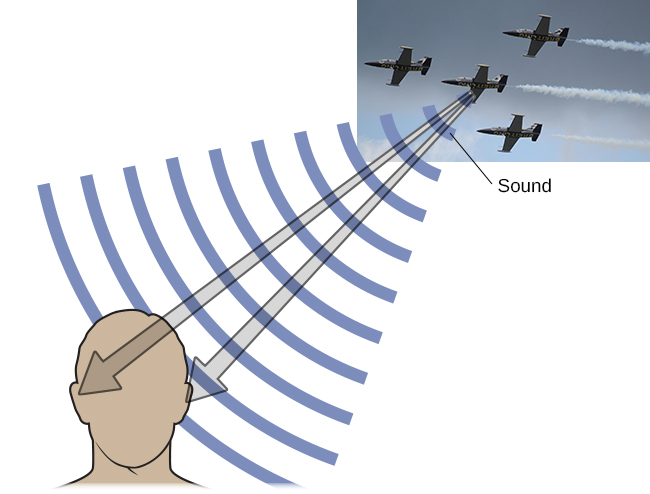
Sound Localization

Marp

Sound localization uses both monaural and binaural cues.

  • Monaural cues: pinna shape → above/below and front/behind
  • Interaural level difference: louder in nearer ear
  • Interaural timing difference: tiny delay between ears → left/right location

Hearing Loss

Conductive hearing loss — failure in vibration of eardrum/ossicles; treatable with hearing aids.

Sensorineural hearing loss — failure in neural transmission from cochlea to brain; most common form.

Causes: aging, noise exposure, trauma, infections, medications.

Cochlear implants — bypass hair cells and directly stimulate the auditory nerve.

The Other Senses

Chemical Senses: Taste (Gustation)

At least 6 taste qualities: sweet, salty, sour, bitter, umami, and fatty.

  • Taste buds on the tongue detect molecules dissolved in saliva.
  • Taste information → medulla → thalamus → limbic system → gustatory cortex (frontal-temporal junction)
  • Taste buds regenerate every 10–14 days.

Taste Bud Anatomy

(a) Taste receptor cells in a taste bud.
(b) Microscopic view of tongue surface.

Chemical Senses: Smell (Olfaction)

  • Olfactory receptors in the nasal mucous membrane detect airborne molecules.
  • Signals go to the olfactory bulb → limbic system and primary olfactory cortex.
  • Dogs have 800–1,200 functional olfactory receptor genes vs. ~400 in humans.
  • Pheromones — chemical signals between individuals (prominent in many species).
  • Taste and smell work together to produce flavor perception.

Olfactory Receptors


Hair-like olfactory receptor extensions protrude into the nasal mucous membrane to bind odor molecules.

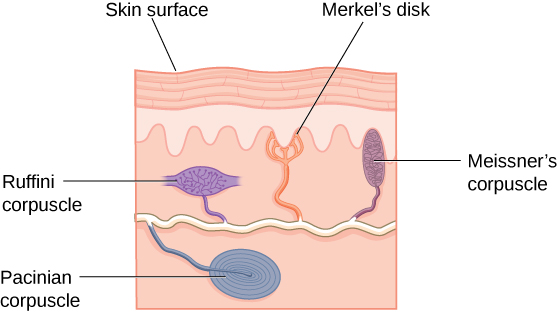
Touch: Somatosensation

Four main types of skin receptors:

Receptor Responds to
Meissner's corpuscles Pressure, low-frequency vibration
Pacinian corpuscles Transient pressure, high-frequency vibration
Merkel's disks Light pressure
Ruffini corpuscles Stretch

Free nerve endings also detect temperature (thermoception) and pain (nociception).

Skin Receptors

Marp

Multiple receptor types in the skin respond to different touch stimuli. Signals travel via spinal cord to somatosensory cortex (postcentral gyrus).

Pain (Nociception)

Pain is adaptive — signals injury and motivates avoidance.

  • Inflammatory pain — signals tissue damage
  • Neuropathic pain — amplified signals from damaged neurons

Congenital insensitivity to pain (congenital analgesia) — extremely rare; individuals sustain severe unnoticed injuries and have shorter life expectancies.

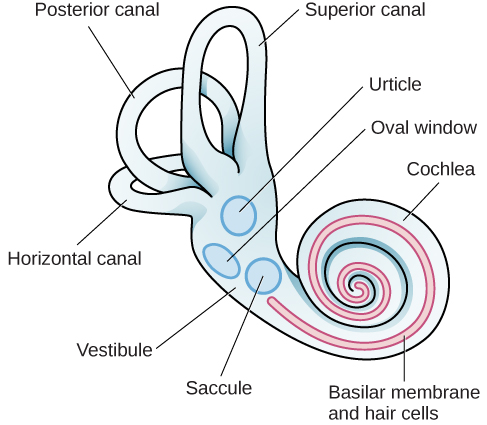
Vestibular, Proprioceptive & Kinesthetic

Marp Vestibular organs (utricle, saccule, semicircular canals) next to the cochlea in the inner ear.
  • Vestibular sense — balance and head/body orientation
  • Proprioception — perception of body position
  • Kinesthesia — perception of body movement through space

Gestalt Principles of Perception

Gestalt Psychology

Founded by Max Wertheimer (early 20th c.), with Köhler and Koffka.

"The whole is different from the sum of its parts."

The brain organizes sensory input into meaningful perceptions in predictable ways — these are the Gestalt principles.

Key idea: perception is an active construction, not a passive recording.

Figure-Ground Relationship


The Rubin vase: perception alternates between a vase (white figure) and two faces (black figure), depending on what is perceived as figure vs. ground.

Proximity

Proximity: things close to each other tend to be grouped together. Left: one block; right: three columns.

Similarity

Similarity: like elements are grouped together. We perceive alternating colored rows rather than a grid.

Good Continuation & Closure

Good continuation: we perceive two overlapping lines, not four separate line segments.
Closure: we perceive complete shapes (circle, rectangle) even when parts are missing.

Perceptual Set & Bias

Perceptual hypotheses — educated guesses when interpreting sensory information, shaped by:

  • Personality and prior experience
  • Expectations and verbal priming
  • Cultural background and implicit biases

Research shows implicit racial bias can affect perception of objects (e.g., misidentifying non-weapons as weapons when paired with racialized images).

Principles of Multisensory Integration

  • Temporal principle: stimuli from different modalities are more likely integrated if they occur at the same time.
  • Spatial principle: stimuli are more likely integrated if they occur at the same location.
  • Inverse effectiveness principle: integration is stronger when individual unisensory signals are weak.

Multisensory Illusions

  • McGurk effect: mismatched audio and visual speech cues produce a third, different percept.
  • Ventriloquist effect: sound source perceived at the visual location (puppet's mouth) rather than the actual acoustic source.
  • Rubber hand illusion: synchronous touch of a fake and real hand induces sense of ownership of the fake hand.

Summary

  • Sensation ≠ Perception; attention, adaptation, signal detection
  • Waves: amplitude → intensity; frequency → pitch/color |
  • Vision: rods/cones, color theories, depth cues |
  • Hearing: hair cells, pitch theories, sound localization |
  • Other senses: taste, smell, touch, pain, balance |
  • Gestalt: figure-ground, proximity, similarity, closure |

Sources

OpenStax Psychology 2e, Chapter 5 (Spielman, Jenkins & Lovett, 2020).
Licensed under CC BY 4.0.
Access free at openstax.org

![bg left w:500](assets/figure_5.19_sound_local.jpg)

![w:600 right](assets/figure_5.23_touch.jpg)

![w:500](assets/figure_5.24_vestibular.jpg)

<img src="assets/figure_5.25_faces_vase.jpg" alt="Marp" width="500" align="left" />

<img src="assets/figure_5.29_closure.jpg" alt="Marp" width="400" align="right" />